
My “L”
2026 06 26

Taking a break from trivial matters like monetary, fiscal, immigration, and climate change policies, I turn to something that truly matters – to me – my name.
Let’s start with the L. That’s for “Lee,” not uncommon for Southern boys born in the 1940s even though it did not mean my parents were great admirers of Robert E ___. Rather it was, I have been told, a reference or substitute for my maternal grandfather’s name, “Levi.” But why the substitution? I’m guessing – it is hard to get data – that “Old Testament” names were going out of style even among Southern Christians in 1942. Or did “Levi” sound especially “Jewish” in 1942 in a way it did not in 1882?
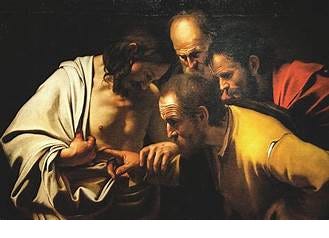
And “Thomas,” “Doubting Thomas.” Some people who know me actually think I am more skeptical about things I hear. I’d like to think that is true, but I suspect that it’s just that I’m skeptical about some popular sources and narratives [that is what Radical Centrist® is all about], not having any general epistemological superiority.
Growing up in a Southern Baptist church I was always chagrined when John 20 was read. If I still felt that way it would be worse now that I’m Catholic as it is an important part of the Easter liturgies. Actually, according to Scripture, Thomas was no more doubting than the rest of the disciples. They did not believe the women who had first seen the resurrected Jesus and accepted it only when they had seen. Thomas was the same. He did not believe the other disciples but did when he saw. And Caravaggio and many other painters to the contrary, Thomas did not take up Jesus’s offer to “Reach hither thy finger, and behold my hands; and reach hither thy hand, and thrust it into my side” but exclaimed, “My Lord and my God!”
In Orthodox tradition, when the Virgin’s death approached, the apostles, scattered across their mission fields, were miraculously gathered to be present at her death. Thomas alone was missing. In most versions he’s off preaching in India and simply can’t be summoned in time. He arrives of some days after the burial. Grief-stricken at having missed her, he asks that the tomb be opened so he can at least venerate her body. When they open the tomb, it’s empty: her body has already been taken up. Paradoxically, Thomas’s desire to see is the occasion for proof of the Assumption (a sacred belief, not a dogma for the Orthodox as it is for Catholics). Should he be called “Missing Thomas” rather than “Doubting Thomas?”
As someone who has lived in Bangladesh and worked in Pakistan, I have to smile that tradition has Thomas as an apostle there.
Which brings me to “Hutcheson,” Hutch’s son, “Hutch” being a form of Hugh [Norman French Hugues from the Old Germanic hug, meaning “heart, mind, spirit.”]. I’m not into tracing ancestry, but I’ll note that the surname figures in the Scottish Enlightenment. A George and Thomas Hutcheson founded a Glasgow hospital in the 1630s, but the big name is Francis Hutcheson, Professor of Moral Philosophy at Glasgow (1730–1746), whose most famous student was Adam Smith, and whose chief critic — though never his pupil — was David Hume.
There is also a Hutcheson port, but as Claude remarks anti-climactically it is, “a 19th-century Scottish merchant’s surname stamped on bottles of unremarkable tawny, surviving mainly as a curiosity for collectors who, as one wine writer put it, like seeing old traditional names on Port labels even when the wine inside was never very special.”
Image: “The Incredulity of St Thomas:” Caravaggio.”
I'm tempted to rename this "Mine "L" to brng back the earlier grammer of My/Mine before words pronounced with consonant/vowel, like a/an. :)