
The Fed's Five Task Forces
2026 07 14

FOMC Chairman Kevin Warsh has announced five “Task Forces for Advancing Monetary Policy, here
The five Task Forces are
Communications: Review how the Federal Reserve conveys policy deliberations and decisions amid uncertainty.
Balance Sheet Policy: Examine the costs, benefits, and institutional implications of the Federal Reserve’s current balance sheet regime.
Data: Improve the quality and timeliness of real economic signals that inform the Federal Reserve’s policy judgments.
Productivity and Jobs: Assess the economic impact of new general-purpose technologies, including artificial intelligence, to inform the Federal Reserve’s policy judgments.
Inflation Frameworks: Revisit how the Federal Reserve understands and responds to the drivers of inflation


Marcus Nunes has commented here but is most interested in #5, as I am, and makes that the topic of his post. Like everything he writes, it is worth reading. But for my purposes I want to have a look at all five. They are not orthogonal and mutually inform each other. There is not a lot in Warsh’s public statements to go on in knowing his intent for the Task Forces. This is appropriate if he intends maximum latitude in the recommendations each may bring. The people that will be leading each Task Force are impressive and both the triumvirate structure and the selection of members with contrasting views point to consideration of a broad range of issues. It’s also convenient as it allows me to put forward the issues in each area I think are important, not to predict where they will come out.
Communications
“My colleagues discussed possible improvements in the form and function of Fed communications. This new Task Force will build on that effort and, I expect, propose some well-considered changes.”
Both words are important, but start with function. As concluded in an earlier post [… What the Fed Isn’t Saying], Fed communication has three functions.
Utility. Communications is a policy instrument; it affects market expectations which in turn affects the response to other policy instruments. If markets expect the Fed to do X it hardly has to actually DO anything to accomplish X. [If the Fed had made clear in 2009 that it was going to use QE to keep the price level ticking up at the pre-crisis level, it might have needed to purchase fewer long-term assets than it did.]
Legitimacy. Congress has granted the Fed great powers, to exercise on its behalf Congress’s Constitutional power [Article I, Section 8] to coin money and regulate its value. The Fed needs continuously to prove that it is worthy of those powers.
Credibility. Markets need to know that Fed actions come from its own judgment of what is needed to achieve its Congressional mandate of price stability and maximum employment not what the president may wish for his advantage.
As for form, long statements by the Chairman or short, dot plot, staff background analysis are all worth re-examining. The key is the content of forward guidance. This should be of the results the Fed expects from its actions, not prognostication about future actions, what movement of policy instruments will be.
Balance Sheet
“Review the benefits and risks of the current ample-reserves regime and the composition of the Fed’s balance sheet … [and] assess alternative frameworks for the conduct and operation of monetary policy.”
Warsh is on record as disliking the Fed’s large balance sheet but the basis of the objection is less clear. Several issues get compounded here: size, term structure, composition, and rate of change/how the change is effected. And each of these has different meanings and policy issues for the asset side or the liabilities side of the balance sheet.
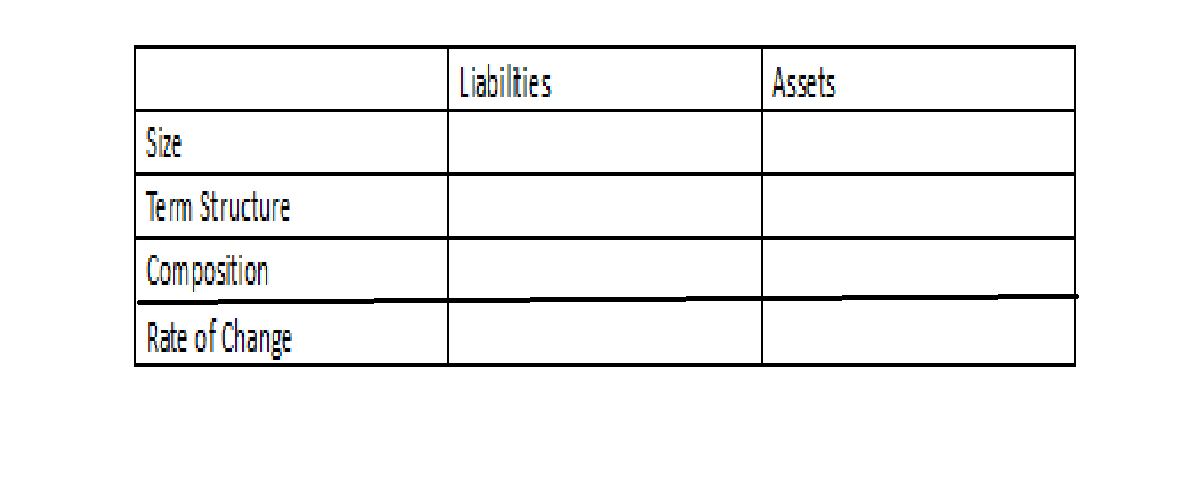
Filling in the 4 x 2 matrix here would disfigure this overview.
Data
“Evaluate new information sources and consider methodological changes to improve data gathering, with the aim of giving policymakers more accurate, relevant, contemporaneous, and, perhaps most important, actionable information on the state of our economy.”
Here it really would be useful to know what problems Warsh has in mind. From his own earlier statements and the leadership of the Task Force it looks like the objective is getting more real time data from private sector sources, things like Task Force leader Chetty’s Opportunity Insights or the (unfortunately no longer active) Billion Prices Project. More, timely, private sector data is good, but what information is to be extracted from the data? Warsh did say “actionable.” Prices seem the most obviously related to the Fed’s mandate and BLS (CPI) and Commerce (PCE) have long lags. Employment is equally important but harder to extract (?) from real time private data.
Without minimizing the usefulness of this focus it seems remarkable narrow. Two areas stand out: expectations and price data methodology. As argued in the Communications section above, expectations to use an overworked LLM phrase, do real work. The Fed ought to pay attention to expectations particularly expectations about their mandated objectives, price stability and maximum employment.
Back in 1997 Treasury began issuing Treasury Inflation Protected Securities (TIPS), carefully paired with non-protected securities to permit extracting market expectation of inflation from trading data. These are issued at 5-, 10- and 30-year tenors and the 5- and 10-year instruments are adequate for tracking how well the anchor to 2% inflation over the long run is holding up. They are not so useful for expectations over 1, 2, or 3 years, which is more like the durations of periods of extreme divergence between actual and target inflation – 2008-09 (negative), 2000 (negative), 2022(positive).
Expectations for GDP growth (the almost exclusive driver of maximum employment) are no less important and for this the Fed has much less to go on. Equities markets being the best choice on a poor menu. They have, paralleling Samuelson’s about economists, predicted 9 of the last 5 recessions. The Fed (the economy generally) needs a better indicator of broad market expectations for growth. This could be accomplished by Treasury starting to issue “Trillionths,” securities similar to Robert Shiller’s “trills,” that pay a fixed percentage of GDP at determined future dates.
Inflation measurement ought to be another major area of concern. The treatment of rent and the rental equivalence for owner-occupied housing and of interest on consumer loans are important for public perceptions of inflation, and hence expectations, and revising them is worthy of consideration. Much more of direct interest to the Fed, however, is wage data. As I argued in https://thomaslhutcheson.substack.com/p/improvements-in-macroeconomic-data, the Bureau of Labor Statistics does not produce indexes of wages as it does of prices of goods and services. Instead, it produces disaggregated unit value indexes which are useful, but are subject to changing composition of jobs, as people with higher or lower wages make up larger or smaller portions of the observed employment category.
There is a similar problem with import and export price data. BLS does not produce price indexes but unit value indexes of imports and exports or disaggregation of prices by degree of exposure to trade shocks even though these have been the important sources of disruption of sectoral relative prices.
A Fed request to Treasury and BLS to produce more useful data would be a reasonable outcome of the Data Task Force.
Productivity and Jobs
“Survey the pace, the reach, [and] the economic impact of new general-purpose technologies, including AI, and explore the implications for the Fed in pursuit of our employment and inflation mandates.”
It’s good to place this task in perspective. The Fed’s entire function is to survey the economy so as to keep the models by which it pursues its mandates current. Presumably this is mainly about AI, although massive high-speed movement of data probably has not run its course. AI in the form of Large Language Models are transforming work.[1] The looming issue is, assuming that AI can raise the productivity of many, potentially very many jobs, how does that affect total employment? And whichever way the impetus lies – the Task Force leadership leans in a no employment loss direction – what are the implications for Fed policy of the mechanisms by which no employment loss occurs?
The easy path to that conclusion is historical analogy. Steam engines, electricity, and ICE vehicles increased labor productivity without producing mass unemployment. They created new jobs, “Why should AI be different?” To which a reply could be, “Why might NOT AI be different?” A growth theoretic general equilibrium economic framework provides a more fruitful path. By analogy with comparative advantage, even if AI can do _any_ job better, more cheaply it cannot do them all equally cheaply and will be used for those which it has a comparative advantage and not others. But even that fails to take account of the rise in total that will create new jobs to be done by AI or humans.
But both these paths require reallocation of demand and employments across sectors. In terms of implications for the Fed, AI is “just” a positive supply shock. Like any other shock, it requires adjustment in relative prices of goods and services, and of land, capital, and labor resources. And like any other shock, the Fed’s response, depends on the size of the shock. One difference, however: compared to a negative supply shock, the potential increase in total output, translated into aggregate demand by Fed policy, means fewer markets in which relative price adjustments are inhibited by downwardly sticky price/wages. The Fed’s job is easier, requiring less over-target inflation when relative prices can adjust without requiring a fall in real incomes of sticky-price resources. And that’s where it ends, or would. Other policies, however, can inhibit the reallocation of resources across sectors, reducing the increase in output, making prices stickier. These would make the AI shock more like a negative supply shock and imply more over-target inflation to maintain full resource employment. Improvements in data will help the Fed see what kind of steed it is riding.
Inflation Frameworks
“Examine the drivers of inflation, first principles, and weigh the full range of ideas for delivering price stability in a changing economy.”[2]
We end where we began. What should the framework be? How to communicate, what to do with the balance sheet, which data to use, what effect AI will have all come down to what the Fed actually DOES, deciding within which framework? Nunes sees the Task Force choosing between or coalescing three different approaches -- New Keynesian (which he takes as the status quo), fiscal theory, and financial stability -- while having omitted consideration of NGDP Level Targeting. I agree that adding NGDPLT to the mix would be an improvement, as would adding back the apparently discarded Flexible Average Inflation Targeting (FAIT) or better said Flexible Price Level Targeting (FPLT). I think, however, the Task Force should be more ambitious.
Starting from first principles of real income maximization and the constraint that prices of different goods and services are differentially flexible, I would wish the group to ask what is the best target toward which Fed monetary instruments of EFFR, IOR, and QE/QT should aim in an economy subject to positive and negative aggregate demand shocks and positive and negative sectoral supply and demand shocks? If they did, I suspect they would come out with _Flexible_ NGDPLT with a rate target built up out of an estimated real productivity growth rate and an optimal rate of change of prices derived from the degree in which “prices of different goods and services are differentially flexible” and estimates of the base level of micro shocks (a “Brownian movement” of supplies and demands). Flexibility would be to allow for different amounts of over-target NGDP when the economy encounters major shocks like the 2008 financial crisis, 2020 Covid/Putin, or a truly disruptive rate of AI adoption.
Image: Five numbered rooms, each with people in intense discussion
[Standard bleg: Although my style is know-it-all-ism, I know that I can be mistaken and am prone to overstate my points. Also, there is an amazing range of views and experiences among readers. Bring those to bear by commenting on these posts. Both other readers and I will benefit.]
[1] They have transformed the job of how this Substack is produced, permitting more ambitions posts that require a lot more work. Whether productivity has increased depends on the value of the additional input.]
[2] Not to make too much of one sentence, but there are a couple of little clouds in Warsh’s statement. The first is, “drivers” of inflation. Perhaps this means no more than exogenous events to which the Fed, as a “driver” needs to take account of. The second is, “delivering price stability.” This is an inflation framework, but the Fed’s job is to deliver both price stability and maximum employment.