
The Question for Powell
2026 04 20

I applaud Nunes for drawing attention to Powell’s Question
The question TO Powell is whether the succession of supply shocks since 2020 — the pandemic, the Ukraine energy crisis, tariffs, now the war in Iran — represented bad luck or something more structural.
Powell:
“You know, we did go through a long period where the shocks were all demand shocks, and so we’ve had a lot of practice thinking about supply shocks in the last four or five years, for sure … But has the world changed? I mean, COVID is a one-time thing, right? This energy supply shock is a one-time thing. It’s not—it’s not because of some broad tendency or anything … I don’t know that the world has changed in a way that there’ll be more supply shocks.”
I agree with Powell and with Nunes approval of all this but I am puzzled by when we have had a _demand shock_ Granted I am using “shock” in a way that Powell probably was not. I mean by _shock_ a large change in sectoral or occupational demands and supplies that requires major changes in _relative_ prices or wages to preserve full employment, changes that require over-target inflation to achieve.
A shock is not the same as a major positive or negative change in aggregate demand. These can be accommodated by changes in monetary policy instruments – mainly interest rates – while preserving target inflation. COVID/Putin was a large negative supply shock that required and received a jolt of over-target infation. The Great Financia Crisis of 2008, in contrast, was a huge fall in aggregate demand, that if acted on quickly and forcefully enough could have preserved trend inflation and prevented a decade of slow growth. [The Fed did NOT act quickly or forcefully enough, but that does not make the GFC into a _shock. _]
Although Nunes admires Powell’s honest expression of uncertainty, Nunes himself is not uncertain.
That era [of relative stability] was made possible by a specific geopolitical configuration: deep economic integration, stable multilateral trade rules, reliable energy flows, and the extraordinary supply-side dividend of China’s entry into the global economy.
… the world has changed.
I agree that “deep economic integration, stable multilateral trade rules, reliable energy flows,” warded off supply shocks. And I also agree that the world HAS changed. Policy choices are creating more shocks. I do not fully agree that “the extraordinary supply-side dividend of China’s entry into the global economy” helped keep shocks minimized. If anything, China’s rise in prominence of world trade WAS a (positive) supply shock in some economies at some times
“And a central banker who anchored policy to a specific geopolitical thesis — “deglobalization is permanent, therefore supply shocks are the new normal, therefore we should tolerate higher inflation” — would be making a category error.”
I disagree completely. Depending on just HOW large and persistent the new higher-shock environment is, a higher flexible average inflation target may be exactly what is warranted. In comments on Claudia Sahm’s “Whiplash Economy” that both Nunes and I praise, I raised [https://thomaslhutcheson.substack.com/p/whiplash] the issue of events de-anchoring inflation, which makes the Fed’s job of minimizing the rate of inflation that maintains full employment more difficult. Nunes rases the more important question of recalibrating the target but is wrong to definitely rule recalibration out.
“What the supply-shock era demands is not a different inflation target or a different policy rule. It demands a different posture toward uncertainty — one that is less confident about mean reversion, more attentive to the possibility that the next shock is not a tail risk but a structural feature, and more willing to communicate that uncertainty honestly to the public.”
Besides not being sure we do not need a higher FIAT, I don’t see that a different Fed “posture” toward uncertainty is needed or even what that means. Have Fed pronouncements in the past reflected too much certainty? I don’t think so.
What pronouncements have reflected is lack of transparency about the Fed’s agency. It is fundamentally dishonest and destructive of public confidence to give the impression that the Fed is constantly fighting inflation instead of constantly managing inflation to get the best combination of stable prices and maximum employment. At times of a large enough shock (positive, negative, demand, or supply) the Fed needs to increase inflation, and it should explain to the public that is what it is doing.
Powell’s question deserves an answer, even if acting on it requires more than monetary policy alone.”
I might agree with this if I knew what it meant.
[Standard bleg: Although my style is know-it-all-ism, I know that I can be mistaken and am prone to overstate my points. Also, there is an amazing range of views and experiences among readers. Bring those to bear by commenting on these posts. Both other readers and I will benefit.]
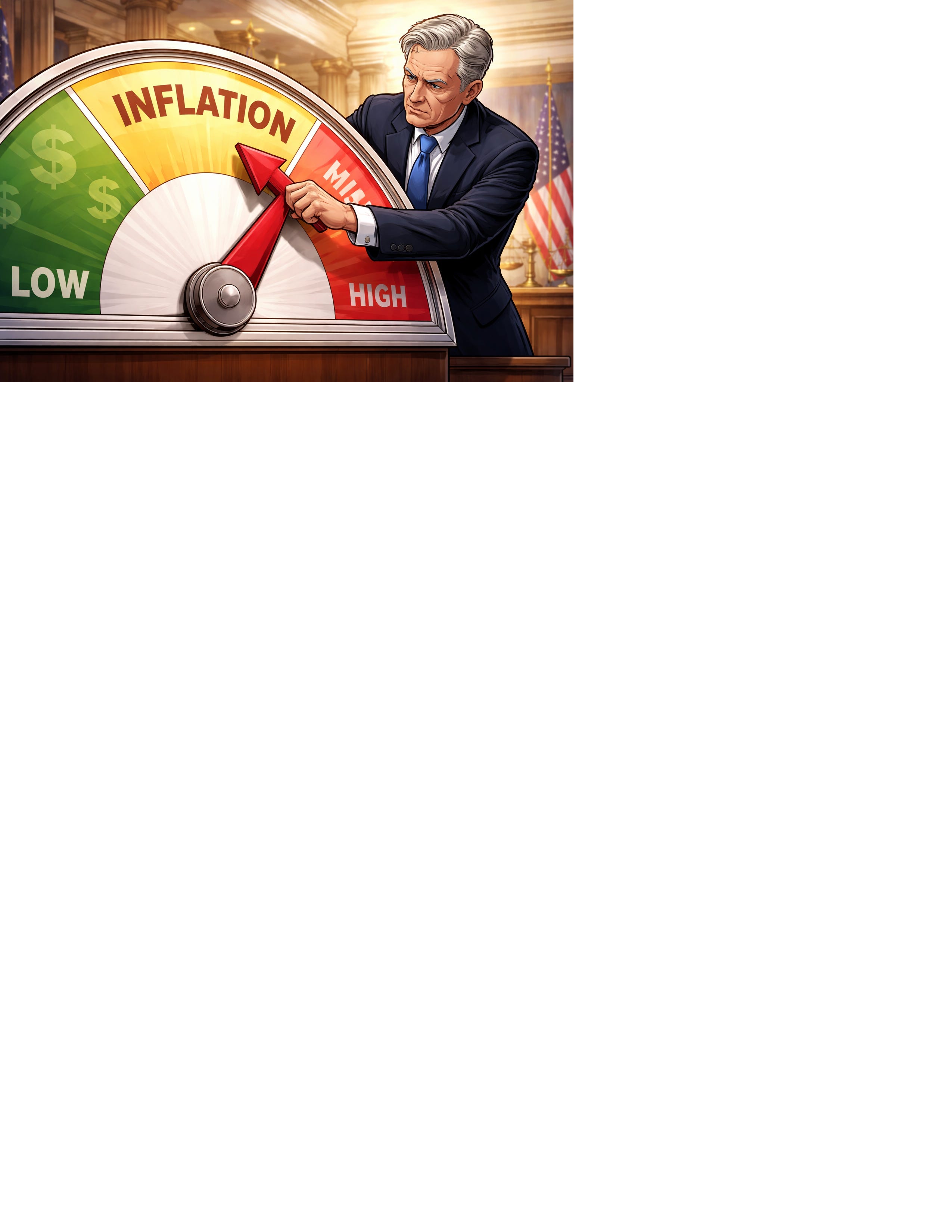
Image prompt: A central banker adjusting an arrow labeled “inflation” through an angle.
.
Beneficiaries of “shocks“ include those segments that can respond to market forces with alacrity.