
Transit Abundance
2026 08 08

Not long ago, DC Abundance organized a meet up around the theme of Transit Abundance. There was an excellent presentation riffing on the paper Stop Paying More for Less Transit from the Institute for Progress’s Transit Abundance Playbook
The problem they address, high transit investment cost is not unfamiliar but the context may be.
The United States once led the world in transit construction. In the 19th century, publicly subsidized railroads[1] catalyzed steel production, agriculture, and even financial markets. In the early 20th century, America built the largest network of streetcar tracks in the world, igniting the first suburban boom and making homeownership and jobs available to millions.
But America has lost its edge. Today, we lead the world in transit construction costs, and build less as a result. America’s first subway line opened in 1897: a 1.5-mile tunnel in Boston built in just four years at a cost of roughly $5 million (about $200 million today). Had we kept costs steady since, we would be nearly on par with other developed countries. Instead, in 2022, New York City’s East Side Access project finally opened after 24 years of construction and $11.2 billion in expenditures — giving it the dubious distinction of being, per mile, the most expensive transit project ever built.[2]
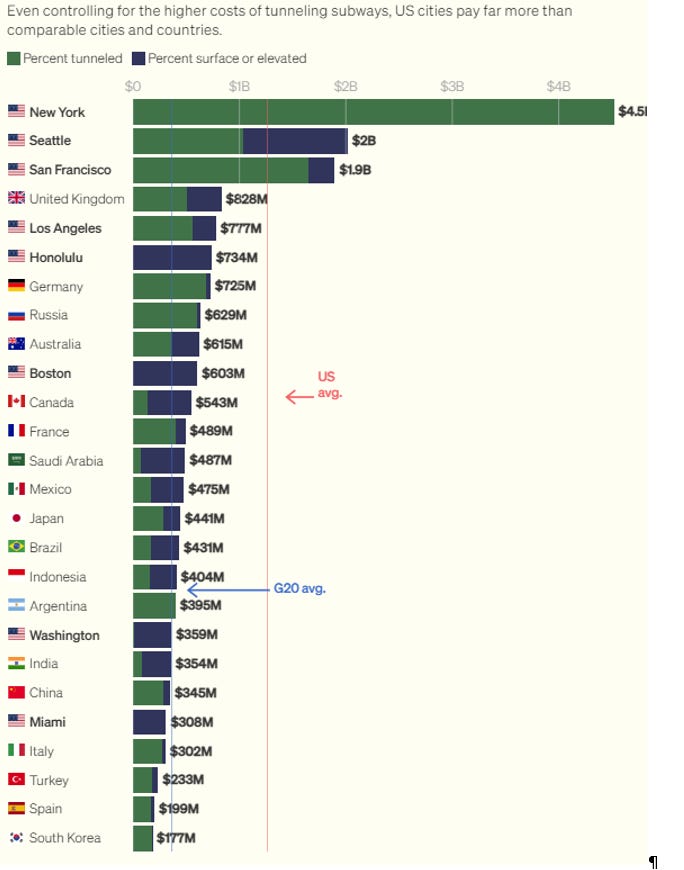
The presentation was not focused, however on documenting a problem but on ferreting out causes which they discuss in six categories
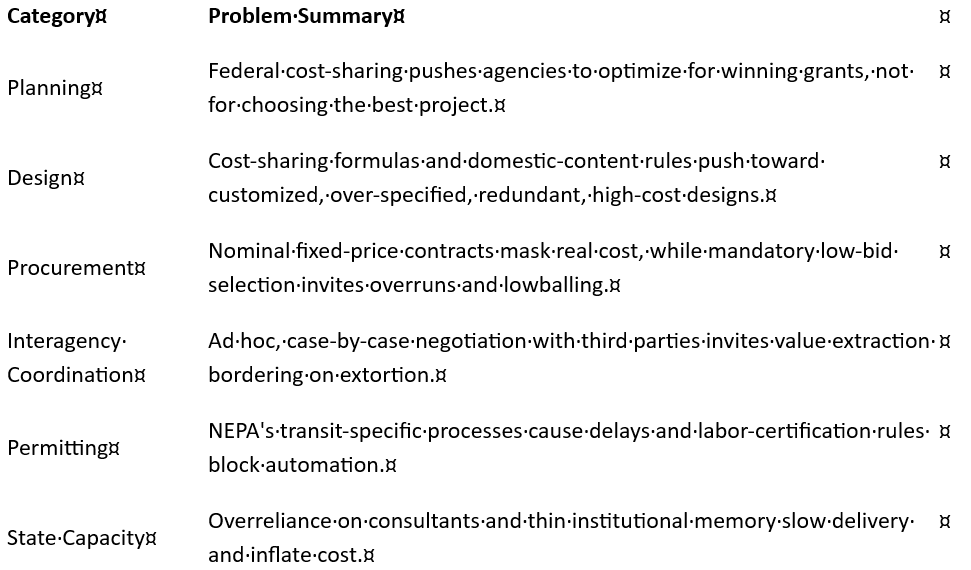
Planning:
Transit projects take an average of 5–7 years to complete environmental review and because these come in the first phase of planning, important (and ultimately costly) operational and constructability concerns, such as utility relocation conflicts or right-of-way acquisition challenges get pushed back against project deadlines. In the Boston Green line, “figuring out how to get the [grant] done before 2014, meant not figuring out the project.” As a result, a project that began as a $1 billion endeavor in 2012 had ballooned to $3 billion by the time the governor paused it in 2015.
Grants follow a linear ‘waterfall’ process, with each of many steps — governed by nearly 60,000 words of statute and regulation — required to wait for completion of the last. Yet these do not sufficiently emphasize cost-effectiveness and early risk assessment,
Design
In Europe, standard, non-articulated diesel buses often cost less than $350,000, compared to $500,000 in the US. As the FTA pays for up to 85% of the cost of buses, transit agencies have little incentive to avoid costly, idiosyncratic design. In 2024 70% of bus manufacturing contracts were unique in at least one feature, ranging from transmissions to seat designs to window tint compared to 45% 20 years ago. Yet in the 1930’s private streetcar companies agreed on a standard design that was manufactured competitively by many companies.
“Buy America” rules that apply to components not just final assembly raise manufacturers’ cost leading some to leave the US market.
US subway construction follows a fire safety standard, which mandates side tunnels that connect adjacent train tunnels every 800 feet, about half the European standard adding about $4 million per mile to construction costs without measurably improving safety
Procurement
Fixed-price contracts look like they protect agencies from cost overruns but they are not real — they mask itemized cost and risk rather than transferring it. Also they do not generate data that other systems and bidders can learn from.
Meanwhile mandatory low-bid selection on those supposedly fixed price – around 60% of jurisdictions legally require low bid selection-- is linked to higher costs, chronic overruns, delays, and “lowballing,” where winning bidders make up the shortfall through change orders. This interacts with low in-house capacity and over use of consultants to evaluate bids.
Interagency Coordination.
Power imbalances exist between the transit agency building the project and the third parties that have to give their approval for the project to advance. Relocating utility assets and some impingement of the value of private assets are legitimate costs of a project, but the approval is sometimes used to extract value from the project in excess of costs “border on extortion.” For example in one particularly egregious case, the City of Beverly Hills denied LA Metro necessary street-closure permits until Metro agreed to build the city a new police kiosk. Sound Transit’s program for light rail construction in Seattle has faced requests for expensive, bespoke parking garages.[3]
Permitting/Regulation
The National Environmental Policy Act (NEPA) requires a comprehensive environmental review of public transit (and other) projects, something not required of private sector projects. Even obtaining a short cut “Categorical Exclusion: (CE) can take transit projects years. Unlike some agencies that allow self-certification, FTA’s administration of the CE is a back and forth intrinsically adversarial process. As IFP explains:
FTA guidance for right-of-way acquisition explicitly states that “[n]o project development on the acquired right-of-way may proceed until the NEPA process for such project development, including the consideration of alternatives, has been completed.” Unsurprisingly, project proponents are often discouraged by the hurdles and oversight required to secure an exemption, and simply defer (or even forgo) acquiring land for that right-of-way. This might lead an agency to build within an existing right-of-way, which avoids regulatory hassle but undercuts the value of the project by moving stations further from jobs and housing
A 1965 regulation intended to be temporary requires that any federally funded project that “would eliminate positions, change job classifications, reduce hours, or reassign workers secure Department of Labor certification that the changes are “fair and equitable” to affected employees.” This is not a safety issue; Systems in Paris, Vancouver and Copenhagen are fully automated. The regulation has the practical effect of preventing any legacy rail transit system from fully automating driving up costs.
One recent study found that automation could reduce US rail transit operating costs by up to 46%, generating an operational profit on the New York and Philadelphia subways, the Boston T’s Red, Blue, and Orange lines, the BART system in the San Francisco Bay Area, and Caltrain.
State Capacity
Specialized consultants have always been important in heavy transit projects. Yet:
Much of the heavy rail construction in the 1970s, ‘80s, and ‘90s in places like Washington, D.C., Atlanta, and San Francisco was managed by agencies with hundreds of staff engineers and project managers on payroll … with per-mile costs much closer to their international peers.,”
Management consultants, however, have less incentive to challenge costly complexity or the inefficiencies discussed above, and their use means that agency staff lose the technical expertise to do so. Moreover, layers of consultancies diffuse responsibility for decisions.
Although some obvious solutions such as eliminating Buy America provisions and self-certification of NEPA compliance, and allowing automation of trains will be politically difficult, IFP attempts to find feasible solutions.
Cost-effectiveness need not be polarizing. Transit advocates should champion spending less, because every wasted dollar is another project never built. Fiscal conservatives have much to gain from faster delivery, because every delay begets more spending. Environmentalists can celebrate the construction of megaprojects that reduce pollution. Cities thrive when the public sector can build, and rural counties deserve buses that aren’t twice as expensive as in peer countries. And more transit ridership means less traffic for drivers
Reflections
Transit Abundance Playbook’s search for ways to reduce the costs of transit projects is clearly the place to start. But not all cost-effective alternative are created equal. An economist like me will ask about the benefits forgone when one alternative is selected rather than another. Granted this is more difficult than minimizing costs as transit investments yield returns over multiple decades and other policies influence this. For example, the value of rail over busses manifests only in the long-term development along corridors and only if land use regulations permit it.[4] Even in prioritizing reform of design decisions, regulations, and institutional arrangements the effects on project benefits cannot be overlooked.
Benefits are also central to another issue: the costly interaction between local agencies and FTA, and unproductive incentives that entails. But suppose federal funding has no negative consequence for local decision-making, a question of benefits remains. Most of the benefits of transit projects are local — what significant non-local benefit are there beyond general shared prosperity? Federal funding is not the only way to provide useful transit services to the public. New York’s first subway line was privately financed with city ownership of the tunnels and stations. DC’s bus (and earlier streetcar) system was privately owned until 1973 Why should federal funds pay for local benefits? If subsidies are warranted to compensate for reduction in traffic congestion or even income distribution grounds, these are local, not national benefits. I love being able to walk 10 minutes to either of two Metro stations to go to the doctor downtown. Why should a friend in Omaha be taxed to help pay for it?
[Standard bleg: Although my style is know-it-all-ism, I know that I can be mistaken and am prone to overstate my points. Also, there is an amazing range of views and experiences among readers. Bring those to bear by commenting on these posts. Both other readers and I will benefit.]
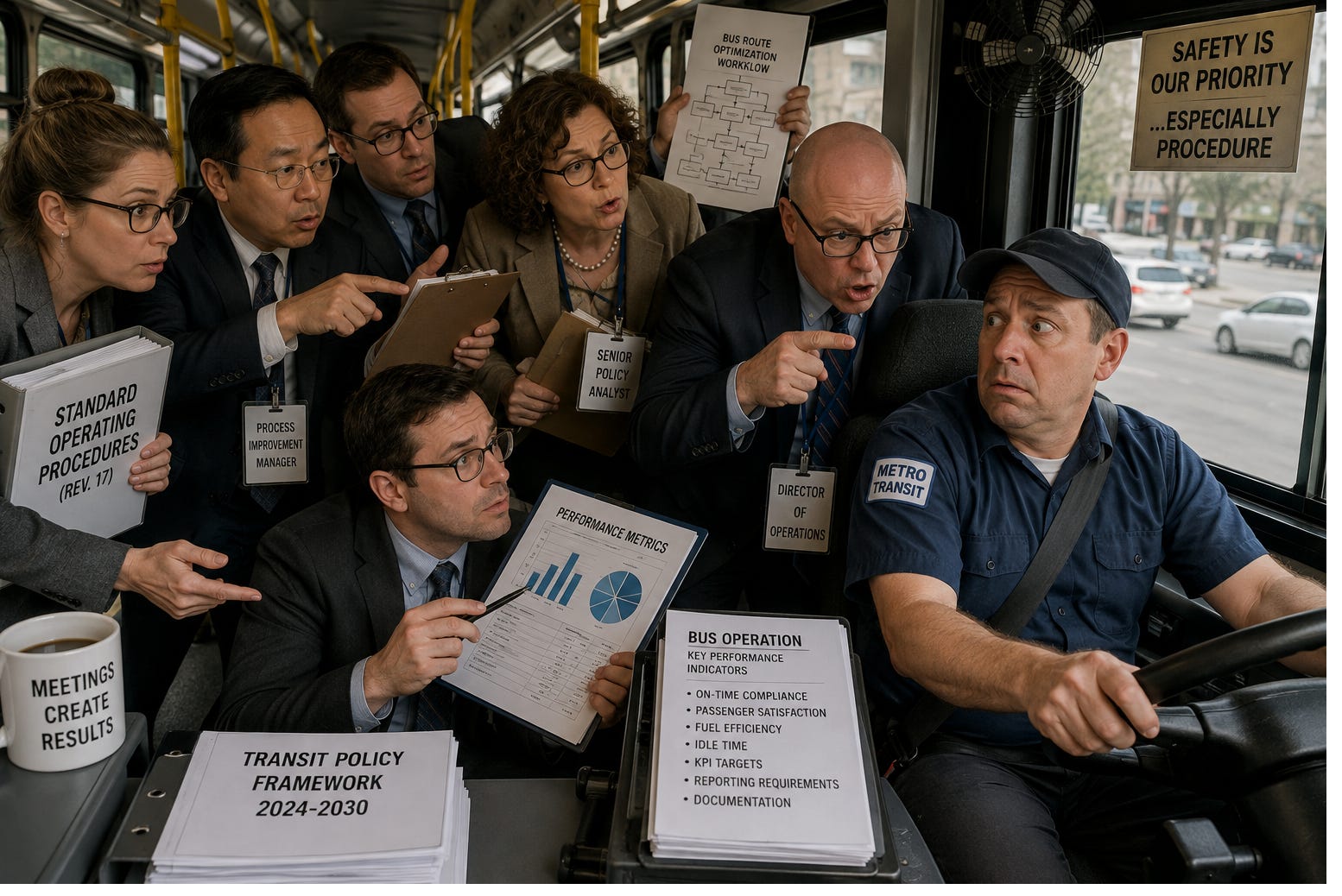
Image: a gaggle of bureaucrats telling a bus driver what to do as he tries to drive
.
[1] I can’t let the implication pass that railroad succeeded because of subsidies, being given public land.
[2] The California LA- SF rapid rail line may be ethe most expensive NEVER built.
[3] IFP attributes those to power imbalances, but I wonder if the prospect of partial federal funding make requestors bolder and transit projects more willing to accede to value extraction.
[4] From casual perusal of the IFP website, it appears that its analyses are conducted mainly by public policy experts with limited economic, opportunity cost, input.
Great, but the fix was always there for the U.S. Our right-wing economists and Americans in general ONLY FEAR government power (and never business monopoly and collusive conduct -- the other famous warning by Adam Smith!). Result: Sealed Bidding required to be Opened to reveal if any of the always-colluding prime contractors CHEATED on the COLLUSIVE BID-RIGGING CONSPIRACY also state, local, and federal building projects! I've talked with contractors who refused to bid on building and public project such as new schools because the OLIGOPOLY had shut him out. SOLUTION: don't open the bids to bust up all trust in rotating "assigned winners each round" for high bids just slightly below the monopoly price! No HONOR AMONG THEEVES requires INFOMATION. Government should have BUYING POWER (like the VA gets for drug prices!) but we refuse to in all other areas (military contract, subways systems, courthouses, etc.).
In the immortal words of Pogo, we have met the enemy and it is us.