
Press Conference
2026 08 01

Everyone and their pet rock has commented about Kevin Warsh’s post-FOMC meeting press conference, none favorably. The best I have seen is Marcus Nunes, “Not a Shift, a Twist”. I give it a five-star Michelin rating. Nunes’s point is that the market reaction, steepening of the yield curve by an increase in the 30-year Treasury bond, demonstrates a diminution of confidence in the Fed’s commitment to its long-term inflation target. The loss stems from a failure of Warsh to communicate a “reaction function,” of the market now knowing what the Fed will do in response to incoming data. Wisely, unlike some other commentators, Nunes does NOT equate this with a failure to provide “forward guidance” about future movements in the EFFR that was left unchanged at this meeting. He does say that Warsh, has not committed to a nominal target.
Well, even five-star eateries should have salt and pepper on the table. [They don’t but they should.] Pace Nunes, Warsh HAS (subject to Claudia Sahm’s important post which I’ll get to later) made a nominal commitment, “we will deliver price stability.” It is not his refusal to give “forward guidance” about next month’s EFFR rate that undermines credibility but rather a) his provenance as Trump’s appointee and b) his lack of nuance about resource employment needing to be part of any nominal commitment. No one can believe a bare inflation target. This is why a commitment to a Flexible Price Level Target or a Flexible Nominal GDP Level Target is needed. Those targets are believable and it is the Fed’s actions and communication strategy (not = “forward guidance”) to make them believed.
It is no challenge to Nunes thesis, but it needs to be borne in mind that the post-conference, 10-year TIPS breakeven inflation movement has been just 6 or 8 basis points. Warsh’s press conference only diminished not upended Fed credibility.
It’s also worth asking how in practice does the Fed communicate a reaction function except by explaining its reactions, which the press conference failed to do. Anyone familiar with Nunes work will know his answer: announce an NGDP level target. The “reaction function” is obvious though implicit, to return NGDP to a pre-set and knowable trajectory if NGDP is not on the trajectory. But what if the target is different or if the NGDP target itself is not invariant with respect to shocks?
Perhaps it is also worth nerding over that the increase in the 30-year rate does not HAVE TO indicate a loss of confidence in the Fed’s commitment to its inflation target. The rate would react the same even if the market expected the Fed to heroically hold out against decades of deficit irresponsibility with higher and higher EFFR’s or QT.
Nunes being Nunes knows this and in a follow up to his post clarifies his point:
I don’t have the thirty-year TIPS reading, which is the one that matters here. If most of the long-end move is real yield rather than inflation compensation, the fiscal reading strengthens and the monetary reading weakens. That’s a check I owe rather than a conclusion I have. The nominal thirty-year is indifferent between compensation for inflation and compensation for supply — a dollar is a dollar. Which is why the split only matters for policy, not for the bondholder: one is fixable by the Fed at no cost, the other isn’t fixable by the Fed at all.
Speaking of QT, Warsh didn’t. Does Warsh intend to shrink the Fed’s balance sheet or not? Why hasn’t anyone else pointed to this silence from Mr. Regime Change? [See the “Balance Sheet” section of The Fed’s Five Task Forces]
Speaking of silence, why hasn’t anyone but Claudia Sahm in Warsh: “We’re Sticking With It”… Until January commented on the unexploded land mine remark about the PCE target?
Who knows come after next January what we might say about strategy. I suspect the task forces might have something to add.
Sahm became concerned in 2% of What about Warsh’s commitment to PCE on the basis of his congressional testimony, but that could have been overlooked as Warsh supping with the Devil using a long spoon. But “sticking with” a long-term target for another 6 months is not sticking at all. Surely this ought to have alarmed bond traders as much as Warsh’s tight-lipped-ness.
And linking this to the Task Force only increase the worry. A Task Force recommendation on how to use more up to date, market derived price date is fine so long as it does not become an excuse to pick a different inflation metric for each macro-political context. See the “Data” section of The Fed’s Five Task Forces]
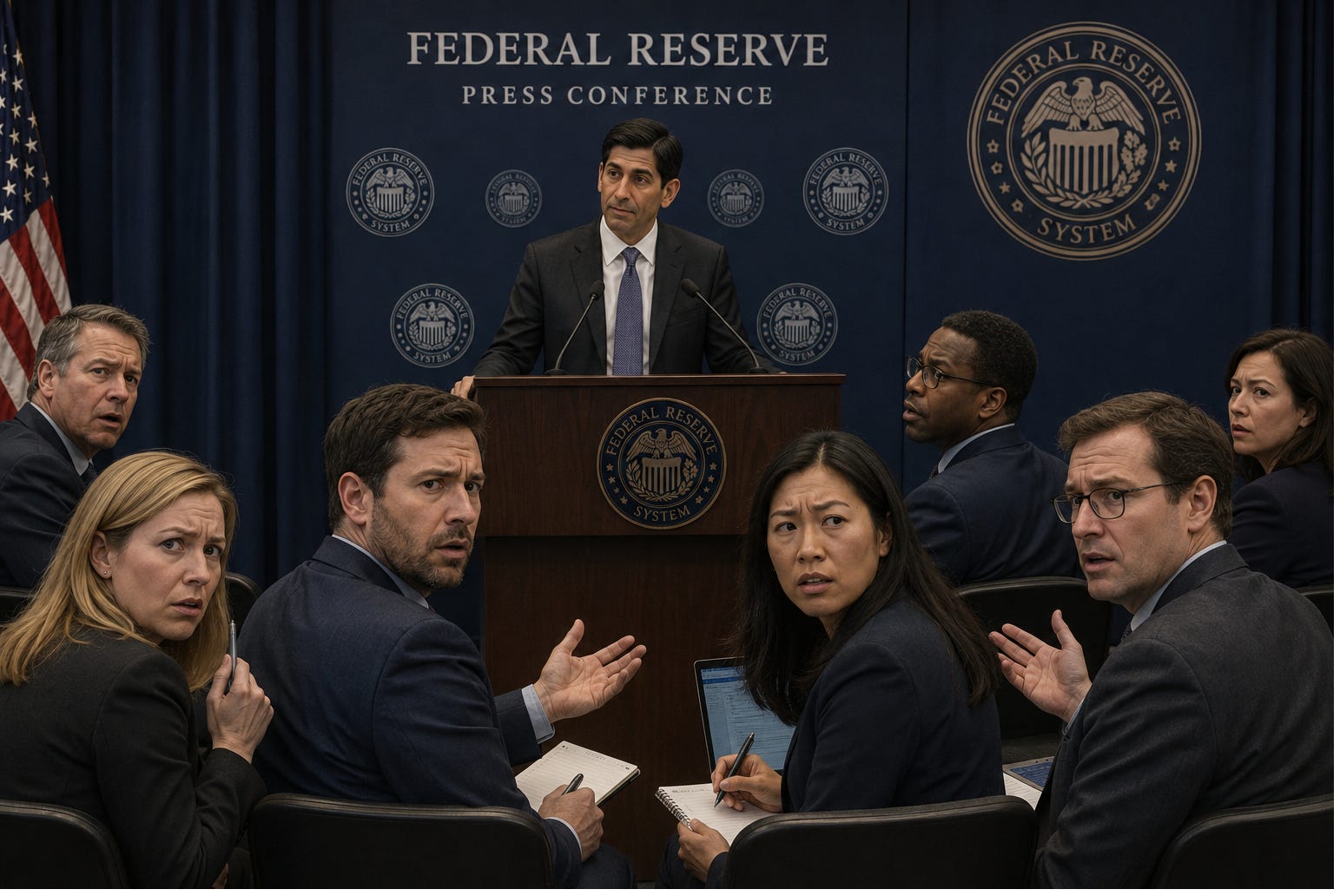
Image: A central bank press conference with the gathered reporters looking at each other quizzically.
[Standard bleg: Although my style is know-it-all-ism, I know that I can be mistaken and am prone to overstate my points. Also, there is an amazing range of views and experiences among readers. Bring those to bear by commenting on these posts. Both other readers and I will benefit.]
Tom, it appears to me that your observations are very biased and are not consistent with my observations of the facts. You seem only to credit academics' interpretations, and to only credit those market reactions that suit your argument. I am not nearly the close observer that you may be, but it appears to my less complete observation that the market has responded positively to Warsh and his commentary, as observed in the fullness of days following the presentation, and not limited to a possibly reactionary immediate reaction by possible special interests in the immediate aftermath.
In my judgment, the generalization is justified to view academia as biased, with the result that there is a predictable academic perspective that does not necessarily depend on factual analysis. I think the market-----in the final analysis, after it reflects all the various distortions----is a far better interpreter.
Time will tell.